
Volkswagen Golf Owners Manual: Correct sitting position
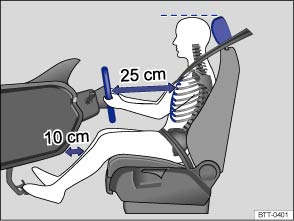
Fig. 41 There must be a distance of at least 25 cm between the driver and the steering wheel The distance to the dash panel must be at least 10 cm in the knee area

Fig. 42 Correct seat belt routing and head restraint adjustment
 First read and observe the introductory information
and safety warnings
First read and observe the introductory information
and safety warnings The following details the correct sitting positions for the driver and passengers.
If any vehicle occupants cannot assume a correct sitting position due to their physical build, they should contact a qualified workshop to find out about possible special modifications. The seat belts and airbags can only provide a maximum level of protection if a correct sitting position is assumed. Volkswagen recommends using a Volkswagen dealership for this purpose.
Volkswagen recommends the following seating position for your own safety and to reduce the level of injury in the event of a sudden braking manoeuvre or an accident:
The following applies to all vehicle occupants:
- Adjust the head restraint so that its upper edge is at the same height as the top of the head, but not lower than eye level. Position the back of your head as close to the head restraint as possible and .
- When adjusting for short people, push the head restraint all the way down, even if the head is then located underneath the top edge of the head restraint.
- For taller people, push the head restraint up as far as it will go.
- Keep both feet in the footwell while the vehicle is in motion.
- Adjust and fasten seat belts properly .
Additional points for the driver:
- Move the backrest into an upright position so that your back rests fully against it.
- Adjust the steering wheel so that the distance between the steering wheel and your breastbone is at least 25 cm and the circumference of the steering wheel can be held at the sides with the arms slightly bent.
- The steering wheel must always point towards the breastbone and not towards the face.
- Adjust the driver seat by moving it forwards or backwards so that you are able to press the pedals to the floor with your knees still slightly angled and the distance to the dash panel in the knee area is at least 10 cm .
- Adjust the height so that you can reach the highest point of the steering wheel.
- Always leave both feet in the footwell, to help ensure you maintain control of the vehicle at all times.
Additional points for the front passenger:
- Move the backrest into an upright position so that your back rests fully against it.
- Push the front passenger seat as far back as possible so that the airbag can provide maximum protection if it is triggered.
 The dangers of assuming an incorrect sitting position
First read and observe the introductory information
and safety warnings If the seat belts are not worn or are worn incorrectly,
the risk of severe or fatal injuries increases. Seat belts can onl ...
 Mechanical controls on the front seat
Fig. 43 Front left-hand seat controls
First read and observe the introductory information
and safety warnings The layout of the controls on the front right-hand seat
is a mirror image of the ...
Other materials:
Overview of fitting locations
Overview of fitting locations - ABS/ESP
1 -
ABS control unit -J104-
Installation location: on hydraulic unit, on passenger side in
engine compartment.
Do not separate connector before successfully completing
self-diagnosis. Switch ...
Rolling resistance optimised tyres
The energy loss caused by the deformation of the tyre when
rolling is known as rolling resistance.
With rolling resistance optimised tyres the deformation is
greatly reduced by a revised design and the use of optimised
tread compositions ...
Routing and securing wiring
Mark lines prior to removal to prevent them from being
interchanged and to ensure that they are fitted in their
original positions. This applies for fuel, hydraulic and vacuum
lines as well as lines for activated charcoal filter system and
electrical wir ...
