Volkswagen Golf Service & Repair Manual: 1-pack anti-corrosion wash primer
| |
1-pack anti-corrosion wash primer -ALN 002 003 10- |
| 1-pack anti-corrosion primer is a zinc chromate-free
one-pack product based on polyvinyl butyral for passenger car
refinishing. |
| The special combination of pigments and binders provides
good corrosion protection and adhesion and is also certified
suitable for application on welded joints. However, because this
product is non-conductive, it is not suitable for use with
spot-weld work. |
| It is recommended to apply a coat of 2-pack HS surfacer over
the 1-pack anti-corrosion wash primer -ALN 002 003 10- at
remaining rust spots on corners and edges, as well as areas
which have been sanded bare. |
| |
Cleaned and sanded electroplated or roller-galvanised steel
panels or soft aluminium |
| |
Lightly sanded factory primer |
| |
Fully cured, solvent-resistant, well-preserved and sanded
factory paint or old paint (with the exception of thermoplastic
paint) |
| |
Surfaces prepared with 2-pack polyester products and then
finely sanded |
|
|
|
| – |
Thoroughly clean with silicone remover -LVM 020 000 A5- or
slow-drying silicone remover -LVM 020 100 A5-. |
|
|
|
| – |
Dry sand using orbital sander with P400 to P500-grain
sandpaper and dust collector. |
|
|
|
| – |
Wet sand with P800 to P1000-grain sandpaper. Completely
remove any rust spots and sand feather edges to old paint. |
|
|
|
| |
2-pack thinner -LVE 009 001 A5- |
| |
2-pack thinner plus -LHA 014 000 A5- |
| |
2-pack thinner, special -LVM 009 200 A2/A5- |
| Method of application: “spray”. |
|
|
|
| – |
Application viscosity 4 mm, +20 °C, DIN 53211 |
|
|
|
| Add 40% thinner at a material temperature of +20 °C |
| – |
If thinner is added, use measuring stick to mix. |
|
|
|
| Application viscosity 4 mm, gravity-feed spray gun
“compliant” and “HVLP”: |
| – |
Adjust spray nozzle following manufacturer's instructions to
1.3-1.4 mm for “compliancy” and “HVLP”. |
| – |
Adjust spray pressure following manufacturer's instructions
to 1.5-3.0 bar for “compliancy”. |
|
|
|
| – |
The specified thickness for the dry film is 15-20 µm. |
| Method of application: “brush” |
 Note Note
| |
When “brushing”, apply the material in one or two
operations. |
| |
Viscosity as supplied is identical to application
viscosity. |
|
|
|
| Flash-off time is 15-25 minutes at +20 °C ambient
temperature. |
|
|
|
| |
Apply 2-pack HS surfacer
→ Chapter |
 C aution
| Do not recoat with polyester products. |
| Do not recoat with epoxy products. |
| Do not overpaint directly with waterborne base coat. |
| Do not use on thermoplastic paint. |
| The following three-stage structure is recommended: |
| |
Prime with 1-pack anti-corrosion wash primer -ALN
002 003 10- |
| |
Isolate with 2-pack HS surfacer |
| The three-stage structure must be used for
galvanised substrates. |
|
|
|
|
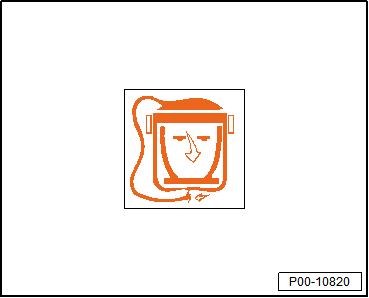
| Personal protective equipment: |
| |
Adhere to the safety data sheet. |
| |
Wear personal protective equipment during application. |
|
|
|
| Viscosity as supplied |
90-100 seconds |
| Flash point: |
Above +23 °C |
| VOC content:
2004/42/IIB(c)(780)780 |
The EU limit value for this
product (product category IIB.c) in ready-to-spray form is max.
780 g/litre of volatile organic compounds. The VOC content of this
product in ready-to-spray form is max. 780 g/l. |
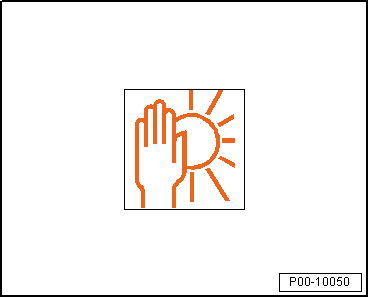
| The guaranteed shelf life is 24 months from date of
production. May be used until the date stated on the label at
latest if stored in sealed original containers at +20 °C. |
|
|
|
Designation:
1-pack wash primer -LVM 044 007 A2-, light grey
1-pack wash primer -LVM 044 171 A2-, dark grey ...
Other materials:
Removing and installing refrigerant shut-off valve for heater and air
conditioner unit -N541
Removing
–
Observe safety precautions
→ Chapter „Safety precautions when handling refrigerants“.
–
Comply with notes
→ Chapter „Working on refrigerant circuit“.
...
Assembly overview - brake pedal, LHD vehicles
Note
The handbrake pedal travel must not be restricted by
additional floor coverings.
Do not lubricate or grease the pivot pin. The pivot pin must
remain dry.
1&n ...
Wheel bolts
Fig. 222 Changing a wheel: loosening the
wheel bolts
Fig. 223 Changing a wheel: tyre valve ①
and locations of the anti-theft wheel bolt ② or ③
First read and observe the introductory information
and safety warningsOnly the spanner delivered with the vehicle should be
used to loosen ...
© 2016-2026 Copyright www.vwgolf.org


 Priming metal
 1-pack wash primer