Volkswagen Golf Service & Repair Manual: Conicity
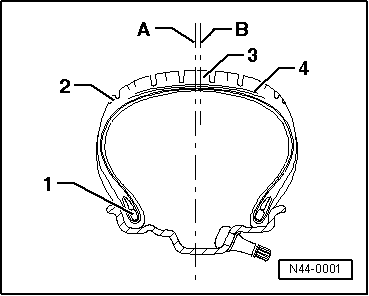
| Conicity is caused by a slight offset of the tread and/or
the belt (amounting to a few tenths of a millimetre) relative to
the geometric centre of the tyre. Taper is not visible and
cannot be measured with equipment available in the workshop. |
|
|
|
| A - |
Geometrical centre of tyre |
| B - |
Actual centre of belt. It can be offset to inside or
outside. |
|
|
|
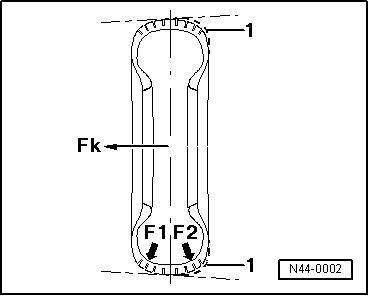
| 1 - |
Offset of belt and tread |
| F1 - |
Unequal vertical wheel forces |
| F2 - |
Unequal vertical wheel forces |
| The offset produces differences in stiffness at the inner
and outer shoulders of the tyre, resulting in differing vertical
wheel forces. Consequently the belt or tread will not be pressed
onto the road surface with the same force (F1, F2). A conical,
or tapered, shape develops. The resulting force (conicity force
Fk) can, depending on the speed, become so great that the
vehicle then pulls to one side. |
| If the force Fk on one wheel of the axle is, for example,
50 Newton, and also 50 Newton on the other wheel, and both
forces are exerted in the same direction, the forces are
cumulated. Reversing a tyre on the rim can compensate for the
lateral pull because the forces then act in opposite directions. |
| Because the direction in which the force of taper is exerted
is not visible, only road tests and strategic rotation of wheels
and tyres can establish which tyres cause the pulling. |
| The tyre consists of numerous components and materials which
are vulcanised to form a single part at the end of a complicated
manufacturing process. The result is differing production
tolerances which make themselves noticeable through more or less
strong lateral forces (conicity forces). These forces can also
occur in new tyres. |
| Pulling to one side on front axle |
| Pulling to one side can be caused by the running gear.
However, experience shows that in 90% of all complaints, the
tyres cause pulling to one side. |
| Pulling to one side during normal driving |
| On a straight, level road surface, the vehicle wants to pull
to one side at a constant speed or with moderate acceleration.
Force can be felt at the steering wheel. |
| Pulling to one side during fast acceleration |
| Pulling to one side during fast acceleration is, in part,
due to the basic design of vehicles with front wheel drive.
Different friction levels at the left and right wheels or
possible irregularities in the road surface (potholes) and
consequently varying road adhesion have a substantial influence
on the handling characteristics. This does not constitute a
complaint which is covered by the warranty. |
|
|
|
Perform a road test to determine whether a vehicle is
pulling to one side and if so, which side. If the vehicle pulls
to one side
→ Chapter.
...
Test conditions before and during the road test:
–
Check all suspension components on the front and rear axles
for damage.
...
© 2016-2026 Copyright www.vwgolf.org


 General
 Remedies when vehicle pulls to one side